
The Greatest Global Restructuring Era is Here & Now: Capital, Debt, Growth & Policies

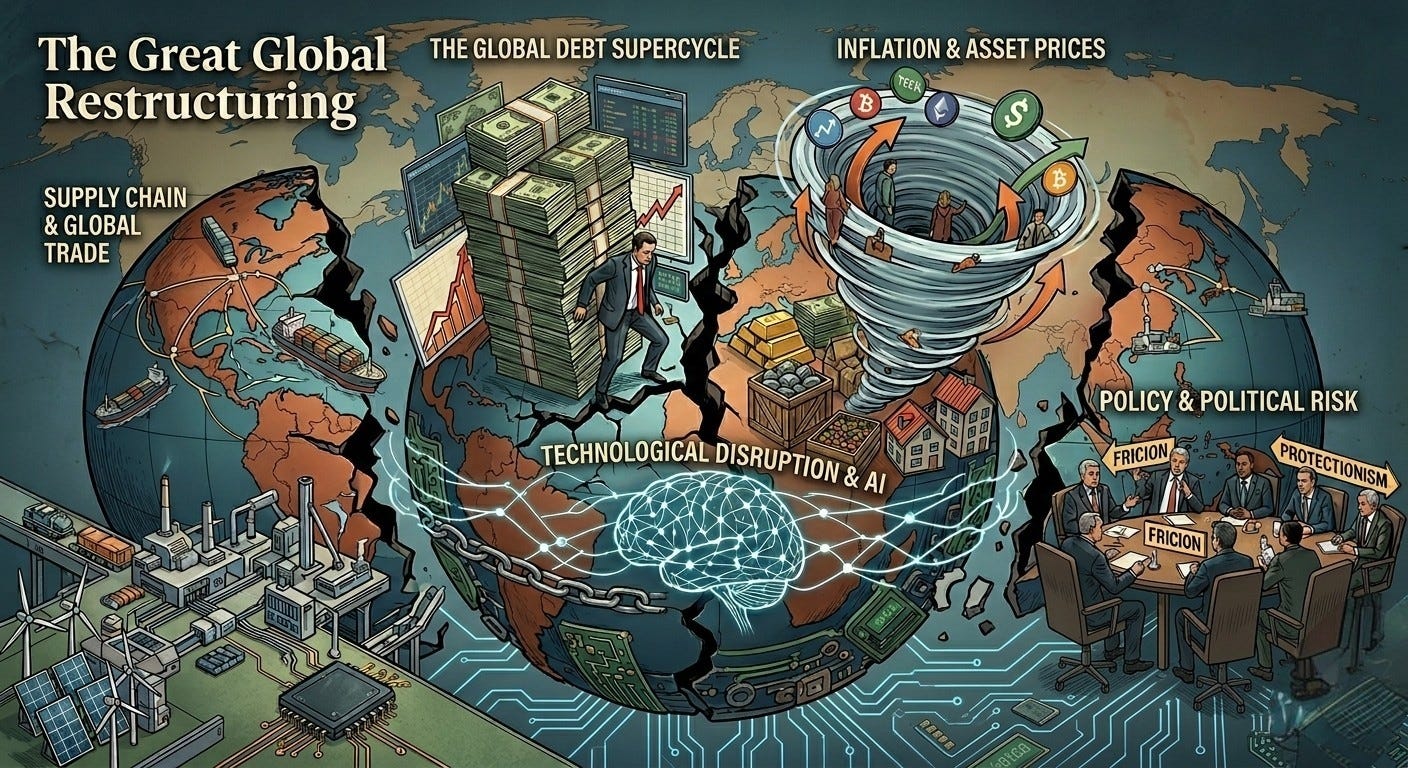
The global economy is undergoing a massive, historic restructuring driven by record sovereign debt, persistent inflation, technological disruption, and heightened geopolitical fragmentation.
Governments and corporations are prioritizing national security, supply-chain resilience, and AI-driven productivity over traditional globalization, forcing a dramatic shift in how capital is allocated.
The complex components of this “Great Global Restructuring” are fundamentally rewriting economic rules.
1. The Global Debt Supercycle
Sovereign Overhang: Global public debt has surged to historic highs (projected to exceed $100 trillion globally, with U.S. national debt alone well over $35 trillion).
Corporate Stress: High interest rates have pushed corporate and lower-quality private credit into a structural stress test, driving a rise in insolvencies and restructurings.
The “Doom Loop”: Rising central bank rates mean debt servicing is crowding out other government expenditures, forcing fiscal austerity or inflationary money printing.
2. Inflation and Asset Prices
“Sticky” Inflation: Ongoing supply chain frictions, deglobalization, and trade tariffs are keeping inflation above historical targets.
Asset Class Rebalancing: Historically high valuations in tech and growth equities reflect the “big debt cycle,” while real assets (commodities, gold, real estate) remain highly undervalued compared to financial assets.
Capital Rotation: Investors are executing a “Great Rotation” out of purely speculative financial assets into hard assets and commodities, which thrive during inflationary decades.
3. Supply Chain & Global Trade
Fragmentation Era: The post-WWII integrated global trading system is fracturing. Multilateral agreements are being replaced by regional, friend-shored supply chains.
Industrial Policies: Government subsidies and industrial policies are heavily backing “national champions” in strategic sectors like semiconductors, critical minerals, and green energy.
Realignment: Trade barriers and protectionist policies are changing trade flows, increasing costs, but also forcing domestic capacity rebuilding.
4. Policy and Political Risk
Politics Driving Economics: Domestic and geopolitical friction are now primary drivers of market volatility rather than temporary external disruptions.
Monetary Dilemmas: Central banks are trapped between keeping rates high to fight inflation and lowering rates to ease the crushing burden of government and corporate debt.
AI Investments: The rapid rollout of Artificial Intelligence is acting as the primary counterbalance to slow economic growth, offering much-needed, deflationary productivity gains.
Sources: Capital Group, PIMCO, OECD, T. Rowe Price, State Street, IMF, Deloitte, Swiss Re Institute, World Economic Forum (WEF), Kearney, Crescat Capital, World Bank, J.P. Morgan