
The 2026 Everything Bubble: Global Wealth at Risk

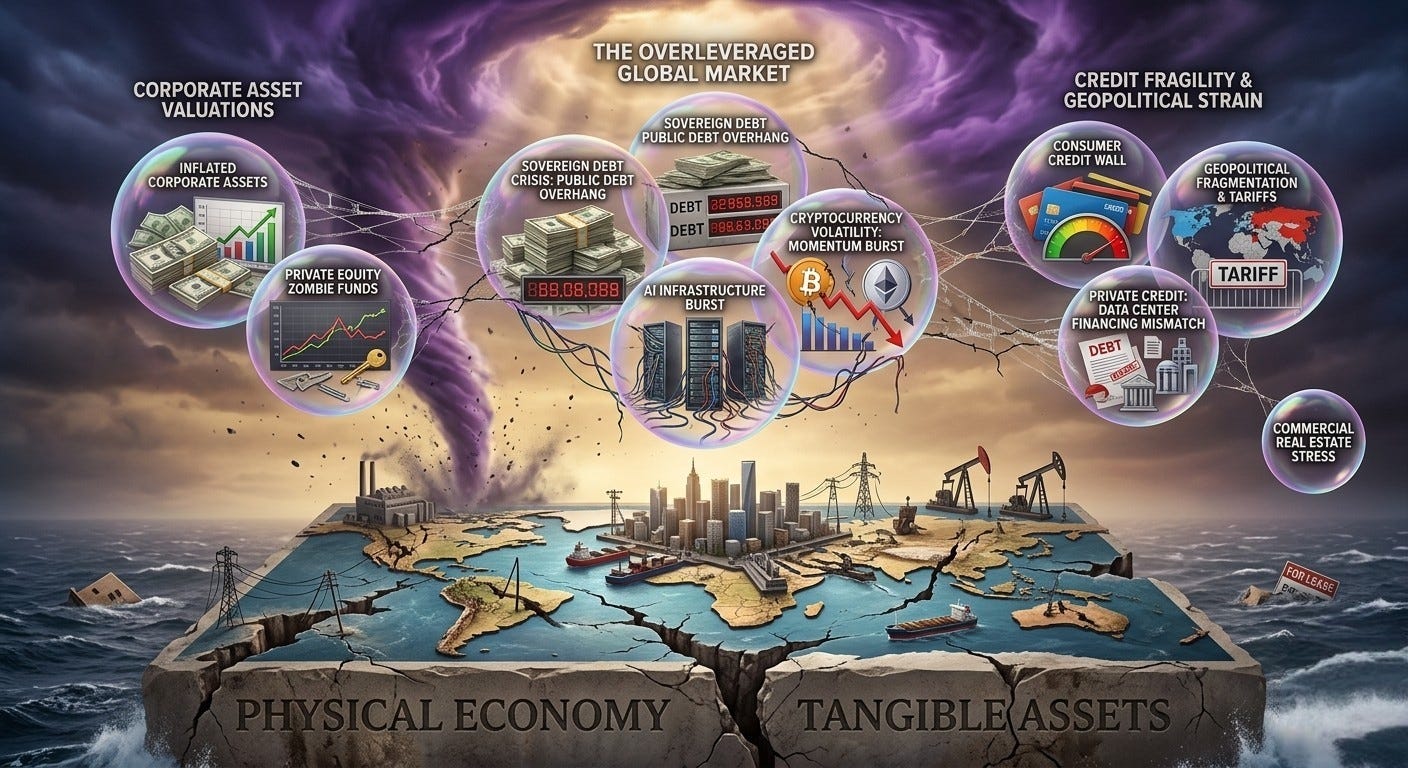
The 2026 Everything Bubble: Global Wealth at Risk
The global economy is currently navigating a dangerous landscape of “everything bubbles,” where prices for everything from stocks to digital coins have climbed far beyond their actual value.
While the “Magnificent 7” tech giants and the AI revolution have driven record-breaking stock market gains, this growth is increasingly fueled by massive debt and speculative hype rather than traditional profits.
As national debts spiral and consumer savings dwindle, the gap between soaring market valuations and the reality of the physical economy has never been wider.
The Primary Market Drivers
The Magnificent 7 & Stock Concentration: A massive amount of market value is tied up in just seven tech giants, creating a top-heavy system. If any of these companies face a regulatory or earnings setback, it could trigger a wider market collapse.
The AI Infrastructure Build-out: Billions are being spent on chips and data centers before the technology has proven it can generate consistent profits. This creates a “mismatch” where debt is high but the actual economic payoff remains uncertain.
Inflated Corporate Asset Valuations: Many companies are valued based on “perfection,” assuming they will grow forever without facing a recession. Accounting for “intangible” assets has made it harder to see the true health of a company’s balance sheet.
Debt and Credit Vulnerabilities
The Sovereign Debt & Public Debt Crisis
Governments in the U.S., Europe, and Japan are carrying record-breaking debt loads that are becoming harder to service.
A “bond bubble” exists where investors may eventually demand much higher interest rates to keep lending to governments.
The Corporate Debt Overhang
Many businesses are “over-leveraged,” meaning they took on too much debt when interest rates were near zero.
As this debt needs to be renewed at today’s higher rates, many companies may struggle to survive.
Private Equity “Zombie” Funds
Firms are stuck holding onto companies they can’t sell, leading to a backlog of assets with “fake” high valuations.
This lack of cash flow is creating a silent crisis within the private investment world.
Commercial Real Estate (CRE) Stress
High vacancy rates in office buildings are causing property values to plummet.
This creates a “ticking time bomb” for the regional banks that hold most of these property loans.
Speculative and Global Risks
Crypto and Digital Speculation
Digital assets continue to see massive price swings based on social media trends rather than real economic utility.
This remains a high-risk area that could vanish quickly if investors flee to “safer” physical assets.
Geopolitical Fragmentation
The world is splitting into competing trade blocs, making it harder and more expensive to do business across borders.
This friction slows down the entire global economy and reduces overall efficiency.
The Rise of Tariffs and Trade Barriers
New taxes on imports are driving up costs for businesses and consumers alike.
These protectionist policies act as a permanent drag on corporate profits.
The Consumer Credit Wall
Rising delinquency rates for credit cards and car loans show that average families are running out of money.
When the consumer stops spending, the primary engine of the global economy stalls.
The current market environment is a complex web of interconnected risks where a pop in one area, like a tech sell-off or a government debt crisis, could quickly spread to others.
We are seeing a historic mismatch between the digital and financial markets and the physical world of manufacturing, energy, and infrastructure.
Protecting wealth in this climate requires looking past the “hype” of high-flying stocks and focusing on the stability of tangible, productive assets.
Sources: GJA Analysis, International Monetary Fund (Sovereign Debt Reports), S&P Global (Corporate Credit Trends), Federal Reserve (Consumer Debt Statistics).